 Skip to content


Red routes can be confusing because the red lines on the road are not simply another version of yellow parking lines. They are designed to control stopping on important, busy roads, and the exact restriction depends on the road marking, roadside signs and any marked parking or loading bay. If you want a broader refresher on sign shapes, colours and meanings, see our UK road signs and their meanings guide.
If you’re learning to drive in London, understanding red routes is especially important. You may need to recognise a restriction quickly, decide whether you can stop, and continue safely without relying on the assumption that a short stop is harmless.
What Is a Red Route?
A red route is a road where special stopping restrictions are used to help keep traffic moving and reduce obstruction. They are particularly associated with London, where Transport for London (TfL) manages a major red-route network. TfL says its red routes make up around 5% of London’s roads but carry up to 30% of the city’s traffic.
The key difference from ordinary parking controls is that red-route restrictions can prohibit stopping itself, not merely leaving a vehicle parked for a long period. That is why saying “I was only stopped for a few seconds” does not necessarily mean a driver has complied with the restriction.
Why Are Red Routes Used?
- To keep high-volume roads moving.
- To reduce congestion caused by stopped vehicles.
- To protect important bus and traffic routes.
- To reduce obstruction around junctions and busy urban areas.
- To make stopping and loading more predictable where activity is permitted.
Where Are Red Routes Found in the UK?
Red routes are strongly associated with London, particularly the Transport for London Road Network. However, red-route style controls are not a concept that should be treated as London-only. Drivers should always rely on the signs and markings at the location they are using rather than assuming that a particular rule applies everywhere in exactly the same way.
TfL Red Routes
TfL manages a network of major roads where red-route restrictions help protect traffic flow. These roads can carry a large proportion of London’s traffic despite representing a relatively small share of the road network.
Local Authority Red Routes
Some London boroughs also operate red routes on roads under their own control. This is another reason to read the roadside signs rather than assuming that every red route is enforced by TfL.
Are Red Routes Only in London?
No. London is by far the place most drivers associate with red routes, but the underlying road-marking and traffic-sign framework is part of the wider UK road system. If you encounter red-route controls outside London, check the local signs and enforcement information for that road.
Red Route Road Markings and Signs Explained
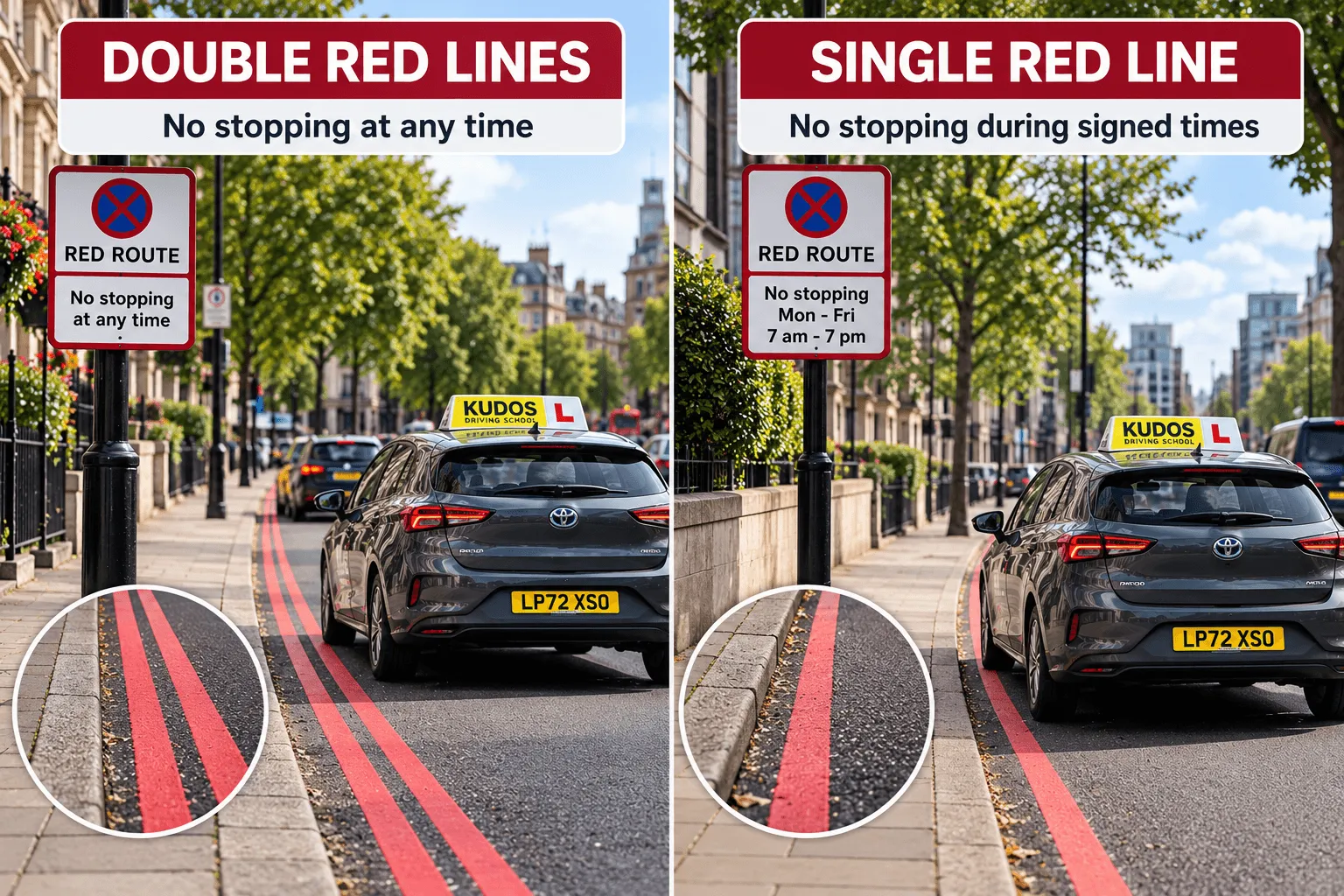
The easiest way to understand a red route is to separate the road marking from the sign. The marking tells you that a stopping restriction exists; the sign gives important information about when the restriction operates and whether a specific bay or activity is permitted.
Double Red Lines
Double red lines mean no stopping at any time. This is the most important rule to remember.
Do not assume that you can stop because you are only dropping someone off, collecting a passenger or unloading something quickly. A specific exception or permitted location must apply.
The restriction can apply to the carriageway and, depending on the control, associated areas such as the verge or footway. Always check the signs and the exact road layout.
Single Red Lines
Single red lines mean no stopping during the days and times shown on the roadside signs.
This is where many drivers make mistakes. A single red line does not automatically mean that stopping is prohibited 24 hours a day. Equally, you should never assume that stopping is allowed simply because you cannot immediately see a time restriction.
Look for the relevant sign before stopping. If the restriction is operating, you must comply with it. Outside the restricted period, other restrictions may still apply.
Red Route Clearways
A red route can also operate as a clearway. In these locations, stopping is prohibited except where a specific permission or marked area allows it. Clearway restrictions are particularly important because a driver may not see the conventional red lines they were expecting.
How to Read Red Route Signs
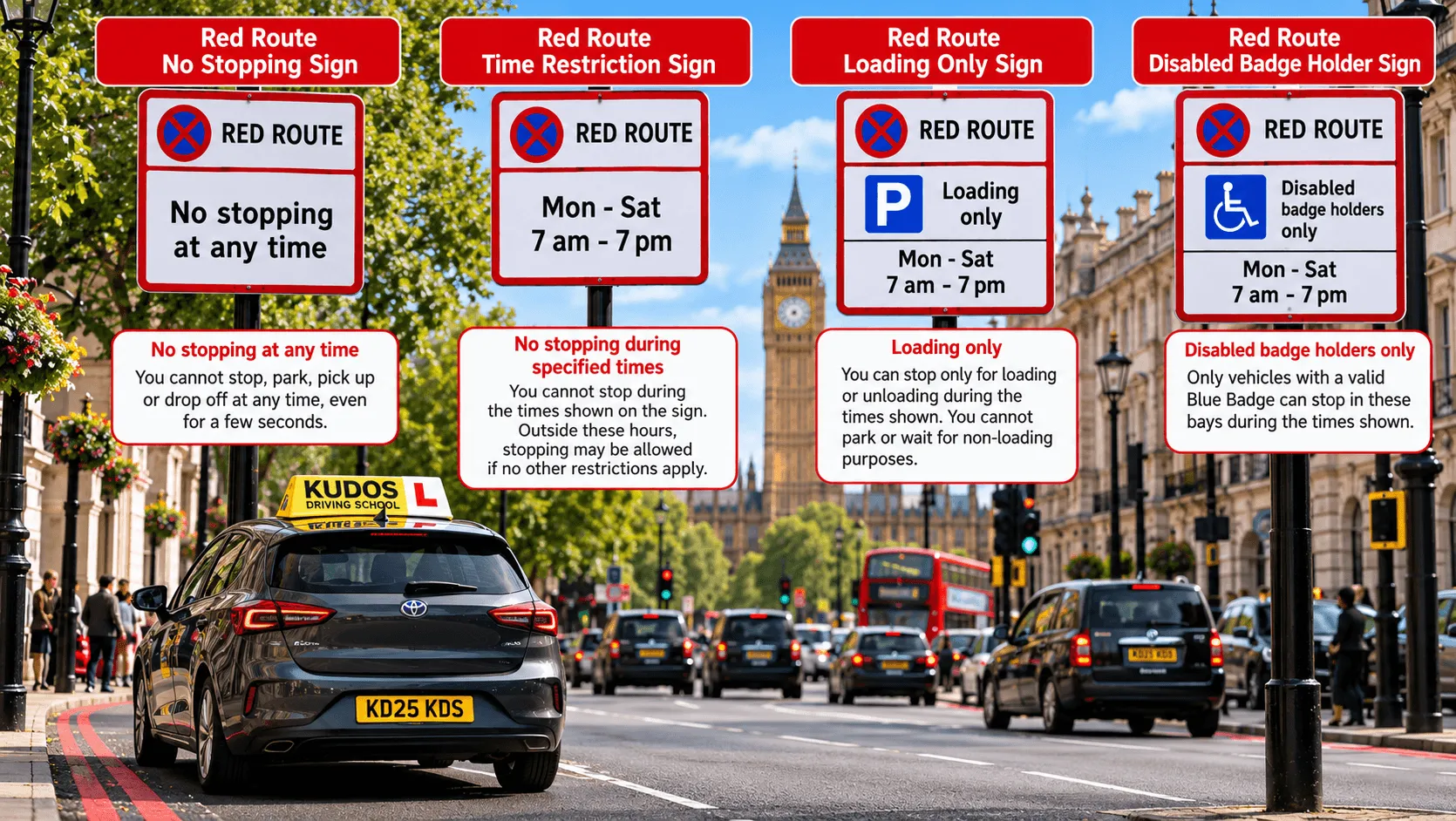
Don’t look only at the colour of the line. When approaching a red route, develop the habit of scanning for the accompanying sign before deciding whether to stop.
- Identify the road marking. Is it a single red line, double red line or a marked bay?
- Find the sign. Check the restriction and its operating times.
- Check the bay. If you are in a parking or loading bay, read the bay-specific sign.
- Check the time. Restrictions can change depending on the stated hours.
- Choose your action. Only stop, park or load if the signs and markings permit it.
Red Route Parking Bays Explained
A marked bay on a red route does not mean “park here whenever you like”. The accompanying sign controls the conditions.
Red Parking Bays
Red-route parking bays can permit parking at particular times or under particular conditions. The sign should tell you when the bay operates, what type of activity is permitted and any maximum stay or other restriction.
White Bays on Red Routes
White-marked bays can also be used on red-route roads. Again, do not treat the colour of the bay as permission by itself. Read the sign beside it and follow its stated conditions.
Loading Bays
Loading is not automatically allowed just because you are actively carrying goods. Where loading is permitted, the relevant sign and bay restrictions determine when it can take place and any maximum period that applies.
What Can and Can’t You Do on a Red Route?
Can You Stop on a Red Route to Pick Someone Up?
Generally, you cannot simply stop on a red line to pick up or drop off a passenger while a stopping restriction is operating. Specific exceptions can apply in defined circumstances, including rules relating to licensed taxis and disabled passengers. If there is no applicable exception or permitted bay, continue rather than stopping because someone is waiting at the kerb.
Can You Park on a Red Route?
Yes, but only where parking is specifically permitted. This may be through a marked parking bay or another clearly signed arrangement. Follow the operating times, maximum stay and any other conditions shown on the sign.
Can You Load or Unload?
Not automatically. Loading and unloading are controlled by the red-route restrictions and the signs at the location. If loading is permitted only in a designated bay or during certain hours, those conditions must be followed.
Can You Wait in Traffic?
If you are stopped because of normal traffic conditions, that is fundamentally different from choosing to stop where stopping is prohibited. A red route does not mean you must somehow keep moving through stationary traffic. The restriction is aimed at voluntary stopping, waiting, parking and other controlled activities rather than forcing a driver to move when traffic itself has stopped.
Parking on Red Routes: Common Situations
Parking on Double Red Lines
You should not stop or park on double red lines because the restriction applies at all times, subject to the specific legal exceptions that may apply.
Parking on Single Red Lines
Check the relevant sign. During the restricted period, stopping is prohibited. Outside the stated restriction, you still need to check for other controls and signs before leaving your vehicle.
Parking in a Red Route Bay
Use the bay only for the purpose permitted by its sign and only for the time allowed. A bay that permits parking at one time of day may have different restrictions at another.
Parking in a White Bay
Follow the sign. The white marking does not override the conditions displayed beside the bay.
Red Route Exceptions and Special Cases
Blue Badge Holders
Having a Blue Badge does not give you a blanket right to park anywhere on a red route. Specific concessions can apply in defined circumstances, but the location, signs and type of bay matter.
In London, Blue Badge holders should pay particular attention to the specific red-route guidance and designated bays. Never assume that displaying the badge automatically makes an otherwise prohibited stop legal.
Licensed Taxis
Licensed taxis have specific provisions for picking up and setting down passengers in certain circumstances. These permissions are not the same as a general right for private cars to stop on red routes.
Emergency Vehicles
Emergency-service vehicles operating in circumstances covered by the relevant rules can have exemptions. That does not create an exemption for ordinary drivers dealing with a non-emergency situation.
Breakdowns and Emergencies
An unavoidable breakdown or genuine emergency is different from choosing to stop because it is convenient. If your vehicle becomes disabled, prioritise safety and follow the appropriate breakdown or emergency procedure rather than treating the situation as ordinary parking.
Red Route Fines and Penalty Charge Notices (PCNs)
Breaking a red-route restriction can result in a Penalty Charge Notice (PCN). For TfL red routes in London, the current PCN is £160, reduced to £80 if paid within 14 days.
The exact penalty and authority responsible for enforcement depend on the road and the organisation managing it. Don’t assume that every red-route PCN across the UK has the same amount.
How Are Red Routes Enforced?
Red routes can be enforced through on-street enforcement and camera-based enforcement. This means a driver should not assume that a brief stop will go unnoticed simply because there is no enforcement officer standing nearby.
Can You Challenge a Red Route PCN?
If you believe a PCN was issued incorrectly, check the notice carefully and follow the representation process provided by the authority that issued it. Useful evidence can include photographs, signs, road markings and information showing the circumstances at the time.
Red Routes vs Yellow Lines: What’s the Difference?
| Restriction | Red route | Yellow line |
|---|---|---|
| Single line | No stopping during the times shown on signs | No waiting during the times shown on signs |
| Double line | No stopping at any time | No waiting at any time |
| Passenger pick-up/drop-off | More restrictive; check the applicable exception or permission | Brief pick-up/drop-off may be permitted where safe and legal |
| Loading | Only where the restriction and signs permit it | Depends on loading restrictions and signs |
| Parking bays | Follow the bay’s specific sign | Follow the relevant parking controls |
The biggest takeaway is that red lines generally control stopping, while yellow lines primarily control waiting. That difference is why a driver who treats a red route like an ordinary yellow-line restriction can easily make a costly mistake.
Common Red Route Mistakes Drivers Make
“I Was Only Stopped for a Few Seconds”
Time alone does not make a prohibited stop legal. Where stopping is banned, the fact that you intended to move away quickly may not help.
“It’s Only a Single Red Line”
Single red lines still prohibit stopping during their operating times. Check the sign rather than guessing.
“I’m Loading, So I Can Stop”
Loading is only permitted where the relevant restrictions allow it.
“I Have a Blue Badge, So I Can Park Here”
Blue Badge concessions are not a blanket exemption from red-route restrictions.
“The Bay Is Empty, So I Can Use It”
An empty bay is not necessarily an unrestricted bay. Read the sign first.
“The Red Line Has Ended, So I Can Park”
Not necessarily. Check for other restrictions such as yellow lines, bus-stop controls, clearways, parking signs and controlled zones.
How to Deal With Red Routes During Your Driving Test
For learner drivers, red routes are less about memorising every possible sign and more about developing good observation and planning.
When following a sat-nav or approaching a busy London road, scan ahead for road markings and roadside signs. If a passenger asks you to stop, don’t allow the request to override the road restrictions. Plan ahead for safe and legal stopping places instead.
This is also good test-driving practice: demonstrate that you can read the road environment, respond to signs early and make safe decisions without last-second braking or unnecessary stops. It also connects with the wider principles of predictive driving, where you anticipate hazards and plan your actions early.
If you’re preparing for a test around Morden, understanding local road layouts and restrictions can form part of broader test-route preparation. You can also read our guide to the Morden Driving Test Centre and our guide to UK road signs and their meanings.
If you’re learning in South West London, Kudos has local driving lesson coverage in Morden, Wimbledon, Tooting, Wandsworth, Mitcham, Croydon, Carshalton and Worcester Park. Choose the area closest to where you live or normally practise.
Frequently Asked Questions About Red Routes
What does a red route mean in the UK?
A red route uses special stopping restrictions to help control traffic on important roads. The exact restriction depends on the red line, sign, bay and operating times.
Can you park on a red route?
Yes, but only where parking is specifically permitted and you follow the conditions shown on the relevant sign or bay.
Can you stop on a single red line?
Only when the restriction is not operating and other signs and controls permit stopping. During the stated restricted times, stopping is prohibited.
Can you stop on double red lines?
Double red lines mean no stopping at any time, subject to specific legal exceptions.
Can you drop someone off on a red route?
Generally, you should not stop on a red line simply to drop off or collect a passenger while the stopping restriction is operating. Check for a specific permitted bay or applicable exception.
Can you load or unload on a red route?
Only where the relevant signs and markings permit loading or unloading and you follow the stated time and duration limits.
Can Blue Badge holders park on red routes?
Not automatically. Specific concessions and designated bays can apply, so Blue Badge holders must check the signs and local red-route rules.
How much is a red route PCN in London?
A TfL red-route PCN is currently £160, reduced to £80 when paid within 14 days. Other authorities may use different penalty arrangements.
Are red routes only in London?
London is where red routes are most widely associated with major traffic routes, but red-route controls are not a concept that should be assumed to be exclusive to London.
What’s the difference between red and yellow lines?
Red lines generally control stopping, while yellow lines primarily control waiting. Red routes therefore tend to be more restrictive for short stops, pick-ups and loading.
How do I know whether a red-route restriction is active?
Check the roadside sign. Single red lines use signs to show when their stopping restriction operates. Always check the sign before deciding to stop.
Red Routes UK: The Rules to Remember
If you remember only a few things, remember these:
- Double red lines: no stopping at any time.
- Single red lines: no stopping during the times shown on the signs.
- Parking and loading bays: follow the specific sign and its conditions.
- Blue Badge: do not assume it gives you unlimited red-route parking rights.
- Picking someone up: don’t stop on a red line simply because the passenger will only take a moment.
- When in doubt: check the sign and continue until you find a legal place to stop.
Understanding red routes is ultimately part of becoming a more observant and predictable driver. That broader approach is covered in our guide to competent driving beyond simply passing the test. If you’re learning in South West London, your instructor can help you practise reading signs, planning ahead and making safe decisions on busy urban roads.
Ready to build confidence on London’s roads? Kudos offers intensive driving courses for learners who want concentrated training, as well as automatic driving lessons for learners who prefer an automatic car. If you’re deciding between transmissions, our manual vs automatic driving lessons guide can help you compare the two before booking.
